Best Mini Pc Buying Guide — Black Friday Deals 2026
Which compact desktop fits the screens, files, and everyday tasks you actually have? The right mini PC is less about choosing the biggest specification on a page and more about matching a processor, memory, storage, operating system, and connections to your setup. This guide compares three distinct options: an entry-level configuration, a small Windows 11 Pro system with an expansion slot, and a model with a broad selection of video and USB connections. During Black Friday, listings can differ by configuration, so verify the exact model and included specifications before comparing offers. No promotion is assumed here; the goal is to make the feature tradeoffs clear before you decide.
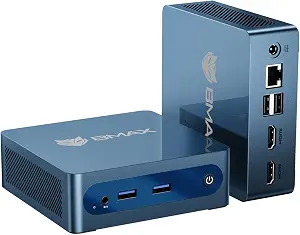
Best Budget is the editorial label for the Bmax Mini PC B1 Plus, a straightforward option to compare when you want a compact desktop built around a modestly specified processor and storage configuration. It uses an Intel Celeron J3355, with a listed speed of up to 2.5GHz, alongside 6GB RAM and 128GB eMMC. Those details provide a clear starting point for deciding whether its configuration matches the tasks and files you have in mind. The label identifies its role among these three picks; it does not claim a particular price, discount, or measured value, especially during Black Friday when listing details should be checked directly.
The dual HDMI ports are useful to factor into a setup that uses HDMI-connected displays. Count the screens you plan to connect, check their available inputs, and confirm whether your desired arrangement calls for any additional equipment. The listing also specifies dual-band WiFi5 (2.4G/5G) and Bluetooth 5.0, which gives shoppers named wireless connection details to compare against their own network and devices. These are specifications, not a guarantee of compatibility with every router or accessory, so check the connection requirements of the equipment you intend to use.
At 4.25 x 4.13 x 1.42 inches, its stated dimensions give you something concrete to compare with the space on a shelf or desk. Measure the intended location and allow for the cables and access your setup needs rather than judging by the word mini alone. The product is described as supporting Linux/Ubuntu, a point worth considering if that operating-system support fits your plans. Do not assume a different operating system or configuration is included: read the exact listing details before ordering, particularly if several versions appear in the Black Friday results.
The B1 Plus can make sense for a buyer who values its listed dimensions, dual HDMI ports, and Linux/Ubuntu support and does not need the larger memory or storage figures shown for the other featured systems. Its 128GB eMMC is a key consideration: think through how much local space your files and applications require, and whether you would rather choose a configuration with an SSD. The processor and memory figures also deserve a realistic look against your intended routine; this guide cannot promise a particular level of performance. For Black Friday, compare the exact product variant and its included configuration, not just the headline or the Best Budget label.
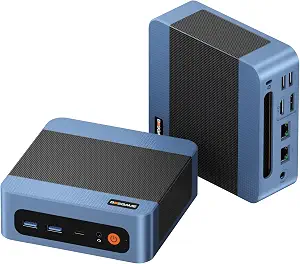
Best Overall is an editorial fit label for the BOSGAME E5 11 Pro Mini PC among the three choices here. Its listed configuration combines an AMD Ryzen 3 5300U processor with 8GB DDR4 dual-channel memory and a 256GB M.2 2280 SSD. That gives shoppers a useful middle ground to consider when they want a Windows 11 Pro system and a solid range of built-in connections, without starting from the more modest memory and eMMC storage listed on the Bmax or the higher-capacity configuration listed on the GEEKOM. The label describes this mix of features, not a measured ranking or a promise that it suits every workload.
For a shared desk, a home-office setup, or a compact computer station, the video choices make it easier to plan around the display connections you already use. The machine lists one HDMI 2.0 port, one DisplayPort, and one Full-Function Type-C port. Check the exact ports on your monitors and any required adapters before buying; the listed connections alone do not establish that every particular display arrangement will work. If a wired network connection matters to your setup, the dual 2.5 Gigabit Ethernet ports are a notable part of the specification. They offer two wired network ports to account for when planning a desk or other connected setup.
Storage planning is another reason to give this model a close look. It has a 256GB M.2 2280 SSD and an extra empty internal M.2 2280 PCIe 3.0 slot. That gives a buyer an identified internal expansion option to weigh against their current file needs. It does not mean an additional drive is included, so confirm what comes in the exact Black Friday listing and consider whether you are prepared to select and install any extra storage separately. At checkout, compare the advertised configuration against these details rather than assuming that similar product titles indicate the same contents.
This is the strongest match in this group for someone who values the combination of Windows 11 Pro, an SSD, an additional internal M.2 slot, and multiple kinds of video output. It is not automatically the right choice if your priority is the lowest-priced offer, the smallest stated footprint, or a particular port that is not listed here. Before a Black Friday purchase, check the listing’s exact model, included memory and storage, and connection descriptions. Choose this option when its specific mix answers your needs; the Best Overall label is a helpful shortlist cue, not a substitute for that check.
Key specs
Processor
AMD Ryzen 3 5300U processor (4 Cores, 8 Threads, up to 3.8GHz boost, 6MB total cache)
Memory and storage
8GB DDR4 dual-channel memory and a fast 256GB M.2 2280 SSD
Storage expansion
an extra empty internal M.2 2280 PCIe 3.0 slot
Video outputs
1x HDMI 2.0 port, 1x DisplayPort, and 1x Full-Function Type-C port
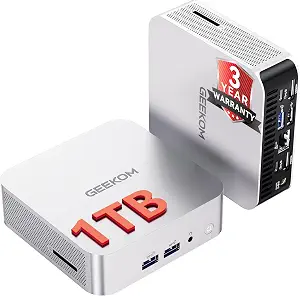
The GEEKOM A7 Mini PC carries the Best for port flexibility label because its listed connections offer several video-output choices and include USB4 ports. That label is an editorial way to point out a feature-based fit, not a claim that it has the most useful ports for every buyer or that it has been tested against other systems. Its configuration includes an AMD Ryzen 5 7535HS processor, 16GB DDR5 memory, and a 1TB SSD. Those specifications make it worth comparing if you want more listed memory and storage than the other featured configurations, while the ports may be the deciding factor for a multi-device workspace.
For video connections, the specifications list one USB3.2 Gen 2 Type-C output at 4K@120Hz and two HDMI 2.0 outputs at 4K@120Hz. They also list two USB4 ports, up to 40Gbps and 8K. Treat those labels as connection details to match against your screens, cables, and other equipment: verify the exact input and capabilities required by each device before assuming a specific setup will work. The presence of several output types gives you more connection options to consider, but you should still map your actual devices before choosing this over a model with a different set of ports.
The 1TB SSD is a prominent part of the configuration for anyone weighing how much local storage they want included from the start. Compare that capacity with your likely files and applications, rather than selecting a system based on a number alone. The 16GB DDR5 memory and Ryzen 5 7535HS processor are likewise concrete specifications to weigh against your intended uses; they are not a promise of results for a particular application. If using an SD card matters to your routine, this model also lists an SD Card Slot. Check the exact listing to confirm the configuration and connections shown for the variant you plan to purchase.
This choice is a natural candidate when your setup involves several kinds of video connection or when USB4 is a priority in your comparison. A shopper who has only one display and does not expect to use those ports may prefer to focus on other needs, such as the Bmax’s stated dimensions or the BOSGAME’s empty internal M.2 slot. During Black Friday, compare the complete GEEKOM listing with the other exact models, including its processor, memory, SSD capacity, and the ports specified here. The Best for port flexibility label can narrow the shortlist, but your own device list should make the final call.
Key specs
Processor
AMD Ryzen 5 7535HS
Memory
16GB DDR5
Storage
1TB SSD
USB-C video output
1*USB3.2 Gen 2 Type C(4K@120Hz)
HDMI video outputs
2* HDMI 2.0(4K@120Hz)
USB4 ports
2*USB4 (up to 40Gbps,8K)
Card slot
SD Card Slot
Sketch your desk connections before choosing
Write down the devices that will connect to the mini PC: display inputs, network cable needs, and any accessories whose connection type matters. Then compare that list with the ports actually stated for each model. The BOSGAME lists HDMI 2.0, DisplayPort, and Full-Function Type-C for video, as well as dual 2.5 Gigabit Ethernet ports. The Bmax lists dual HDMI ports. The GEEKOM lists HDMI and USB-C video outputs, two USB4 ports, and an SD Card Slot. These differences can be more useful than a vague idea that one computer has “enough ports.”
Check whether your monitor and cables match the named connections, and confirm the capabilities you need from each device. A port description does not establish compatibility with every display, dock, or accessory, so verify those requirements independently. If you are shopping for a multi-screen arrangement, trace each intended connection before checkout and note any adapter requirements. Do not count on a connector merely because it looks familiar: match the exact port type and stated function. For Black Friday, apply that same connection checklist to the precise listing and variant you are considering; similar product names do not replace checking the specifications.
Choose a configuration that suits your routine
Start with the work you expect the computer to handle, then use the processor and memory as comparison points rather than guarantees. The Bmax lists an Intel Celeron J3355 and 6GB RAM; the BOSGAME lists an AMD Ryzen 3 5300U and 8GB DDR4 dual-channel memory; the GEEKOM lists an AMD Ryzen 5 7535HS and 16GB DDR5. These are distinct configurations, but this information alone cannot predict how a particular application will behave. Consider what you actually run, how many tasks you tend to keep open, and whether the operating system you want is supported by the exact model.
The operating-system details differ too. The BOSGAME is listed as a Windows 11 Pro system, while the Bmax specifies support for Linux/Ubuntu. No operating-system detail is supplied for the GEEKOM in these records, so check its listing rather than making an assumption. Make a short requirements list before browsing: necessary software, preferred operating system, memory expectations, and the connections your work depends on. This can stop an appealing Black Friday headline from distracting you from a missing detail. If your requirements are uncertain, compare the configurations carefully and verify anything essential on the exact product page before deciding.
Let local storage needs guide the shortlist
Think about what you keep on the computer: applications, active projects, and files you want available locally. The featured configurations are not alike: the Bmax lists 128GB eMMC, the BOSGAME lists a 256GB M.2 2280 SSD, and the GEEKOM lists a 1TB SSD. Consider whether you prefer a smaller included capacity, an intermediate listed capacity, or more storage included in the configuration. The figures are useful for comparing the products, but only you can estimate how much room your routine calls for. Avoid assuming that an unlisted cloud service, drive, or storage accessory is included.
The BOSGAME has an extra empty internal M.2 2280 PCIe 3.0 slot, which is a specific expansion option to factor into a longer-term plan. It does not mean an extra drive comes with the system, and it is not a reason to skip checking the exact configuration. If adding storage later is part of your plan, verify what is required and whether you are comfortable handling that step. For Black Friday, look beyond a large headline capacity: match the listing’s stated drive type and capacity to the product you intend to buy, then compare any stated expansion details. Select the configuration that addresses both your current files and your own plans.
Treat room, wireless, and networking as practical requirements
Measure the spot where the computer will sit and think about the way its cables need to reach your display, network, and accessories. The Bmax provides stated dimensions of 4.25 x 4.13 x 1.42 inches, so you can compare that exact footprint with your available space. Do not infer dimensions for the other two models from their product category; check their listings if their physical size matters to your arrangement. A computer that fits the space still needs practical access to its connections, so account for cable routing and the places you may need to reach.
For wireless details, the Bmax lists dual-band WiFi5 (2.4G/5G) and Bluetooth 5.0. The BOSGAME specifies dual 2.5 Gigabit Ethernet ports if wired networking is part of your setup. The supplied information does not establish the wireless details for the other models, so confirm those on their exact listings if they are important to you. Compare your network and accessory needs directly with the stated features rather than treating a missing detail as proof that a product lacks it. During Black Friday, check the configuration and listing carefully before relying on any connection assumption.
Make a Black Friday comparison that survives checkout
A Black Friday offer is only comparable when you know which exact product and configuration it applies to. Check the model name and product variant, then confirm the listed processor, memory, storage, operating-system details, and connections against the specifications you need. If two listings use similar titles, do not assume their configurations match. Likewise, a headline promotion does not establish the final offer or product contents. Compare the information shown at checkout with the item you intended to select, and pause if an essential detail is unclear.
Use a simple decision order: rule out systems that do not meet your connection or operating-system requirements; compare storage and memory for your routine; then assess the exact offer displayed for each eligible configuration. The labels in this guide are editorial shortcuts among these three products, not market-wide awards or proof of performance. Look for the feature that made a system relevant to you—the Bmax’s stated dimensions, the BOSGAME’s expansion slot, or the GEEKOM’s collection of listed ports—and verify it on the exact listing. That keeps Black Friday shopping focused on fit rather than an unsupported assumption about savings.
Make your Black Friday choice
Before buying, run one final check: confirm the exact model and variant, match its processor, memory, storage, operating system, and ports to your needs, and verify the offer shown for that listing. Choose the Bmax if its specified configuration and compact dimensions fit your priorities; consider the BOSGAME for its Windows 11 Pro system and additional internal M.2 slot; or shortlist the GEEKOM if its stated video and USB4 connections suit your setup. Those are different feature tradeoffs, not a universal ranking. Black Friday can be a useful time to compare listings, but the right decision is the exact configuration you have checked and would choose on its merits.