ASUS TUF Gaming GeForce RTX 5090 32GB GDDR7 OC Edition Gaming Graphics Card Buying Guide — Black Friday Deals 2026
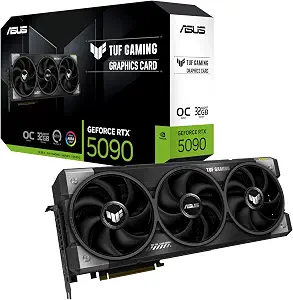
The ASUS TUF Gaming GeForce RTX 5090 32GB GDDR7 OC Edition is a specific card to evaluate by its listed memory, connections, clock modes, dimensions and cooling feature—not by assumptions about what the RTX 5090 name guarantees in a particular system. Its 32 GB of GDDR7 and multiple native display outputs are useful starting points for shoppers deciding whether the card matches their plans. During Black Friday, treat the event as a time to compare the exact model and offer, rather than as proof that a price is reduced or that this variant suits every build.
Best for display planning, this ASUS TUF Gaming model lists Native DisplayPort 2.1a x3 and Native HDMI 2.1b x2. Those connection details give shoppers something concrete to compare with the displays they intend to use: check each display’s input, the connection arrangement you need and any cable or adapter requirements before ordering. The listed outputs are not, by themselves, a promise that every display setup will work exactly as planned. On Black Friday, confirm that the offer is for this precise ASUS TUF Gaming GeForce RTX 5090 variant, rather than relying on a similar product name or a broad RTX 5090 category label.
The card lists 32 GB of GDDR7 graphics memory, a default boost clock of 2550 MHz and an OC mode clock of 2580 MHz. These are useful identity and specification details when comparing listings, but they do not establish how a particular game or application will perform. Consider the tasks you expect to run and consult the software and system information relevant to your own setup. For a Black Friday purchase, compare the card’s full name and stated specifications with the exact listing so that the memory type, capacity and clock-mode details match the product you intend to buy.
ASUS lists Axial-tech fans as a cooling feature and gives the card dimensions as 13.7″L x 5.7″W. Those facts help frame two practical checks: whether the listed cooling design is a feature you want to consider, and whether the stated dimensions work with the space available in your build. The fan detail alone does not establish noise, temperatures or cooling results, and the dimensions alone cannot establish fit in every case. Before a Black Friday checkout, compare the measurements with your case documentation and check any other system requirements in the product listing and your system documentation.
Turn the listed outputs into a display checklist
Start with the screens you actually plan to connect, not with a general assumption about what a high-end graphics card should support. This model specifies Native DisplayPort 2.1a x3 and Native HDMI 2.1b x2. Write down the input available on each intended display, then compare that information with the card’s stated outputs. If your setup involves different connection types, check the relevant display and cable documentation before deciding whether additional equipment is needed; the provided specifications do not state that cables or adapters are included.
This is especially useful during Black Friday, when similarly named listings can make quick comparisons tempting. Check the complete model name and the output specification on the exact listing you are considering. Count and type can matter to your planned arrangement, but the listed ports do not guarantee a particular resolution, refresh rate or simultaneous-display behavior. Verify those details against the product listing and the documentation for your displays. That approach keeps the decision focused on a confirmed connection plan instead of an assumption based on the RTX 5090 name.
Choose memory capacity with your workload in mind
The stated graphics memory is 32 GB, and its type is GDDR7. Those are clear points for comparing this card with another listing or checking that a product page describes the variant you meant to select. Think about the applications and games you plan to use, and consult their published requirements or guidance when deciding what memory capacity makes sense for your use. The specification alone does not say how much memory a particular workload will need or predict the experience it will deliver.
A Black Friday comparison is more useful when it separates confirmed facts from expectations. Confirm that a competing listing identifies its memory capacity and memory type clearly, then consider whether its other specifications fit your priorities. Avoid treating a larger-sounding number or a model-family label as a substitute for checking the exact card. If memory is one of your main reasons for considering this ASUS model, keep the listed 32 GB and GDDR7 details together when verifying the offer.
Read the two clock entries as product details
ASUS lists a default mode with a 2550 MHz boost clock and an OC mode at 2580 MHz. The two entries help distinguish the stated clock configurations, but they are not a measured comparison of performance and should not be used to predict results in a specific game or application. If the mode matters to you, check the product page for how ASUS describes access to it and review any relevant system or software documentation before making that part of your decision.
When comparing Black Friday offers, make sure the clock information belongs to the exact variant in the listing. Similar names can make it easy to overlook a model distinction, so compare the full product name and its stated specifications rather than assuming every RTX 5090 card has these same entries. A shopper who does not care about the mode distinction can still use the two values as a useful listing cross-check, while keeping performance expectations grounded in information specific to their intended software and setup.
Plan around the stated card dimensions
The listed dimensions are 13.7″L x 5.7″W. Before buying, compare those exact figures with your case documentation and the room available in the area where the card would be installed. Consider the surrounding parts and any space constraints identified by your system documentation; the provided dimensions do not describe every possible clearance or establish compatibility with a particular case. If you are uncertain, check the case and card documentation rather than relying on a visual estimate or a general description such as full-size.
Black Friday can reward careful verification more than a fast checkout. Look for the dimensions on the exact product listing and confirm that you are comparing the same ASUS TUF Gaming model. If the listing you are considering does not make the relevant information clear, pause to verify it before purchasing. This is a practical way to avoid choosing solely on the RTX 5090 label when the physical space available in your own build is also part of the decision.
Give the cooling feature the right weight
Axial-tech fans are the cooling feature specified for this card. If fan design is a priority in your comparison, this provides a concrete detail to investigate in the product listing. It does not state noise levels, temperatures or results under a particular workload, so avoid treating the feature name as proof of any of those outcomes. Consult the listing and other system documentation for details that matter to your particular use, and compare like-for-like information if you are weighing multiple cards.
During Black Friday, this distinction can help keep a decision grounded. The presence of a named fan feature is a confirmed specification; whether the card’s overall cooling behavior suits your needs is a separate question that the available details do not settle. Balance the fan information with the memory, output, clock and dimension details that matter to your setup. If you cannot verify a detail that affects your purchase, treat it as unresolved rather than filling in the gap with an assumption.
Compare the exact offer, not a broad product label
For a Black Friday decision, first match the listing to ASUS TUF Gaming GeForce RTX 5090 32GB GDDR7 OC Edition. Then check that the stated memory, native outputs, clock entries and dimensions correspond to that exact variant. Compare the offer details shown on the listing at the time you shop, but do not assume that an event mention means a promotion is active or that a particular price represents savings. The available product facts establish specifications, not a sale price, discount or stock status.
Finally, weigh the confirmed details against your own priorities: display connections, memory, the listed clock modes, physical space and the stated fan feature. Keep compatibility questions tied to the documentation for your system and intended displays. A careful, model-specific comparison makes Black Friday shopping more deliberate and reduces the chance of confusing this card with another product in the same graphics-card family.
Key specs
Graphics memory
32 GB
Memory type
GDDR7
Video outputs
Native DisplayPort 2.1a x3, Native HDMI 2.1b x2
Default boost clock
Default mode: 2550 MHz(Boost clock)
OC mode clock
OC mode: 2580 MHz
Card dimensions
13.7″L x 5.7″W
Cooling features
Axial-tech fans
Make your Black Friday choice
This ASUS card is easiest to assess when you connect each listed specification to a real decision: match its native outputs to your display plan, consider 32 GB of GDDR7 alongside your intended software, and check the stated dimensions against your build documentation. Treat the clock entries and Axial-tech fans as product details, not guarantees of particular results. On Black Friday, verify the exact variant and the offer shown before ordering; a careful match to your needs matters more than an event label.
 Check Price on Amazon